- Jupyter Notebook 95.3%
- Python 4.5%
- Makefile 0.2%
| Filename | Latest commit message | Latest commit date |
|---|---|---|
| config | ||
| docs | ||
| models | ||
| notebooks | ||
| references | ||
| reports | ||
| src | ||
| .gitignore | ||
| Aleksa_Radojičić_20240165_Presentation.pdf | ||
| Aleksa_Radojičić_20240165_Thesis.pdf | ||
| LICENSE | ||
| Makefile | ||
| README.md | ||
| requirements.txt | ||
| setup.py | ||
| test_environment.py | ||
| tox.ini | ||

Second-Hand Car Prices Prediction using Machine Learning Algorithms
This project was developed for my Bachelor's thesis at the Faculty of Organizational Sciences, Information Systems and Technologies. The goal was to predict prices of second-hand cars listed on the Serbian platform PolovniAutomobili using machine learning algorithms in Python.
Project Overview
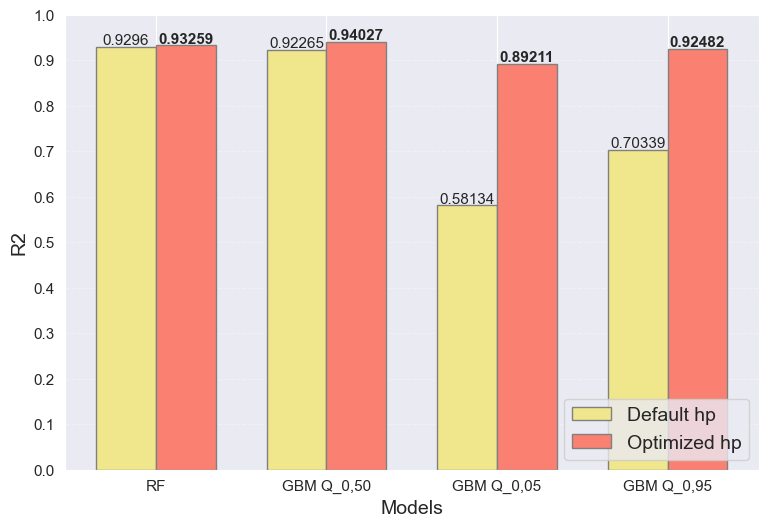
The objective of this project is to accurately predict prices of second-hand cars in euros using various ML models. The dataset consisted of 23,759 cars for training and 5,940 vehicles for testing. Coefficient of determination [R2] was the main metric used for models evaluation. Hyperparameters for Random Forest and Gradient Boosting Model were optimized using cross-validation. Furthermore, optimized GBMs were used to predict 90% prediction intervals.
GBM model performed best, achieving R2 of 0.94027 and MAE (mean absolute error) of 1230.770€ on test data. The prediction intervals contained the true values only 43.38% of the time. The 0.50 quantile GBM model identified the production year as the most important attribute, followed by engine power, kilometerage, model name and others.
Data Acquisition
Vehicles were scraped from the website PolovniAutomobili using BeautifulSoup and Tor. SQLAlchemy and MySQL were used to store the data, resulting in a total of 30,788 rows and 50 columns.
Technologies Used
- Programming Language: Python 3.11.8;
- Database: MySQL, SQLAlchemy;
- Web Scraping: BeautifulSoup, Tor, Stem, Selenium, tbselenium;
- Data Analysis: Pandas, NumPy;
- Visualization: Matplotlib, Seaborn;
- Machine Learning: scikit-learn;
- Configuration: PyYAML, Hydra.
Data Preprocessing
The Initial Cleaner component processed each column and removed outliers. The resulting data was passed then into a Preprocessor Pipeline, which prepared train and test set separately for modelling. Price (output column) was log-transformed to further improve model performance.
Results
Below are the tables of performance metrics for the optimized models on both the training and test sets.
Train Set Metrics
| Model | RMSE | MAE | R2 |
|---|---|---|---|
| RF | 1191.538 | 499.685 | 0.98717 |
| GBM 0.50 | 1579.571 | 547.138 | 0.97746 |
| GBM 0.05 | 2470.072 | 974.428 | 0.94488 |
| GBM 0.95 | 1435.852 | 818.770 | 0.98137 |
Test Set Metrics
| Model | RMSE | MAE | R2 |
|---|---|---|---|
| RF | 2726.884 | 1311.138 | 0.93259 |
| GBM 0.50 | 2566.822 | 1230.770 | 0.94027 |
| GBM 0.05 | 3449.857 | 1715.0888 | 0.89211 |
| GBM 0.95 | 2879.736 | 1624.346 | 0.92482 |
Additionaly, there is a comparison of R2 between the default and optimized ML models, along with a plot depicting true versus predicted values on the test set (GBM), including prediction intervals.
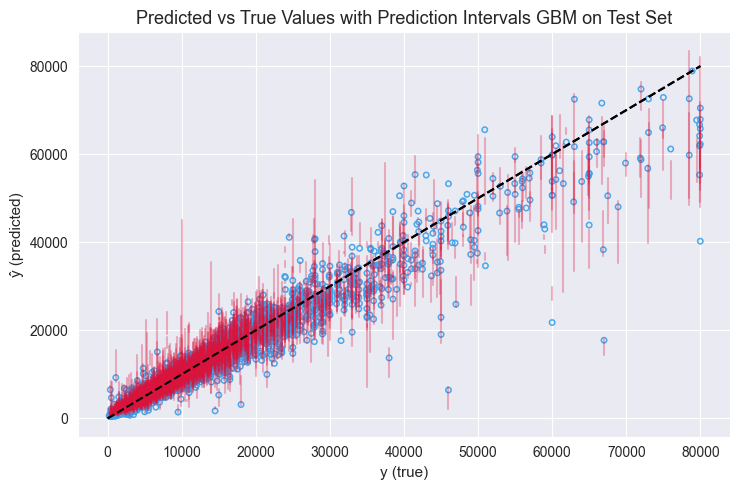
Comparing Default and Optimized Models on Test Set using R2 Metric (GBM)
Bachelor’s Thesis and Presentation
Both the thesis and presentation are available as PDFs in this repository. Files:
Acknowledgements
I really want to thank my mentors Sandro Radovanović and Andrija Petrović for their guidance and support throughout this project.